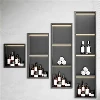
Stainless steel niches, as a home component combining decoration and practicality, are widely used in living rooms, bathrooms, and toilets. Their production process integrates design, processing, and installation, with each step directly affecting the final product's quality and aesthetics. The following details the entire process of making a stainless steel niche.
Design and Planning
The production of a stainless steel niche begins with detailed design and planning. This stage requires comprehensive consideration of factors such as spatial layout, functional requirements, aesthetic style, and budget constraints. The designer will create preliminary design drawings based on the client's needs, including dimensions, shape, color, and material selection. For stainless steel niches, 304 or 316 stainless steel is typically chosen due to its excellent corrosion resistance and strength. The design process also needs to consider the niche's load-bearing capacity to ensure it can safely support the placed items.
Material Preparation and Cutting
Based on the design drawings, stainless steel sheets of appropriate thickness are selected for preparation. The stainless steel sheets must undergo strict quality inspection to ensure they are free of defects and deformation. Next, using a high-precision laser cutter or waterjet cutter, the various components of the niche are precisely cut according to the design drawings. This step requires extremely high precision; any minute error can affect subsequent assembly and installation.
Stamping and Bending
The cut stainless steel sheets undergo stamping and bending processes to form the three-dimensional structure of the niche. Stamping creates holes or grooves of various shapes on the sheet to meet design requirements. Bending, on the other hand, bends the sheet into the desired shape, such as right angles or rounded corners. This process requires the use of specialized bending machines and strict control of the bending angle and radius to ensure the stability and aesthetics of the niche structure.
Welding and Assembly
After stamping and bending, the welding and assembly stage begins. Welding is a crucial step in the fabrication of stainless steel niches, directly affecting their structural strength and sealing. High-precision welding techniques such as argon arc welding or laser welding are typically used to ensure smooth welds free of porosity and cracks. After welding, the weld seams are ground to ensure a smooth transition with the base material surface. Next, the various components are assembled according to the design drawings and secured using screws or welding to form a complete niche structure.
Surface Treatment and Decoration
The assembled stainless steel niche requires surface treatment to enhance its aesthetics and corrosion resistance. Common surface treatment methods include brushing, polishing, electroplating, and spraying. Brushing gives the niche a delicate texture; polishing makes its surface smoother and brighter; electroplating enhances its corrosion resistance and provides a variety of color options; spraying can be customized with various colors and patterns according to customer needs.
Quality Inspection and Packaging
The completed stainless steel niche undergoes rigorous quality inspection, including dimensional accuracy, structural strength, surface quality, and functional testing. Only niches that pass all inspections are considered qualified products. Qualified products are then cleaned and packaged using materials such as foam boards and cardboard boxes for protection, ensuring they are not damaged during transportation.
Installation and Commissioning
Finally, the packaged stainless steel niche is transported to the customer's designated location for installation and commissioning by professional installers. During installation, ensure that the contact surface between the niche and the wall or floor is flat and secure, avoiding any shaking or tilting. After debugging, provide cleaning and maintenance instructions for the niche to ensure that the customer can use and maintain it correctly.