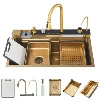
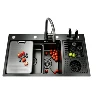
Install the faucet (if not pre-installed): Insert the faucet into the pre-drilled hole in the sink and tighten the bottom fixing nut with a wrench. Connect the water inlet pipe (hot and cold water pipes must be distinguished), and wrap it with Teflon tape to prevent leaks.
Install the drain assembly: Place the sealing ring on the bottom of the drain assembly, insert it from inside the sink, and tighten the fixing nut. Connect the drain pipe, and use PVC glue or a sealing ring to ensure the connection is leak-proof.
Countertop installation: Apply sealant to the edge of the sink and align it with the cut-out hole in the countertop. Secure the edges with clips, remove excess sealant, and let it cure for 24 hours.
Undermount installation (more aesthetically pleasing): Apply sealant to the contact point between the sink edge and the countertop, and lift the sink from below to fit the countertop. Secure it from the bottom using a metal bracket or screws to ensure stable load-bearing capacity.
In-wall installation: Requires precise drilling, ensuring the sink edge is flush with the countertop, and seal the edges with sealant.
Connect the water inlet and outlet systems: Connect the faucet inlet pipe to the angle valve (cold/hot water). Install the drain pipe, ensuring a slope (to prevent water accumulation), and consider installing a odor-proof water trap.
Testing and finishing: Turn on the faucet to check for leaks and test the drainage speed. Use a level to confirm the sink is installed flat, adjusting as necessary. Clean off excess adhesive and let it sit for 24 hours before use.
Installation Precautions
Sealing: Apply sealant evenly to avoid gaps.
Load-bearing safety: Undermount sinks require additional reinforcement to prevent detachment after prolonged use.
Rust prevention: Add waterproof strips to the edges of the sink to prevent moisture corrosion.
Drainage slope: The drain pipe should maintain a 1%-3% slope to ensure rapid drainage.