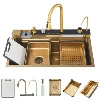
A kitchen sink is an essential fixture for every kitchen renovation. It is used daily for washing vegetables, dishes and cookware, and its durability and practicality directly affect your daily kitchen experience. Many homeowners struggle with a common question: which is better, a stamped stainless steel sink or a handmade stainless steel sink? What are the actual differences, and which one is more suitable for household use?
Most budget-friendly sinks on the market are stamped sinks, while handmade sinks are the preferred choice for mid-to-high-end home renovations. In this guide, we will compare the two types in detail and explain why handmade stainless steel sinks are favored by industry professionals for residential kitchens.
1. Core Process Differences Between the Two Sinks
1.1 Stamped Sink (Machine One-Piece Stamped Forming)
Stamped sinks are mass-produced through standardized industrial assembly lines. They are shaped by pressing and stretching a whole stainless steel sheet with large industrial molds. This manufacturing method features fast production and low cost, making stamped sinks affordable and widely used for low-budget renovations and commercial projects. However, the process has obvious limitations with fixed shapes and thin, uniform plate thickness, resulting in ordinary texture and poor durability.
1.2 Handmade Sink (Artisan Custom Cutting & Polishing)
Breaking the fixed limitations of machine stamping, handmade sinks are crafted from high-quality thickened stainless steel plates through precise manual cutting, bending, splicing, full welding and fine polishing processes. Free from standard mold restrictions, they feature exquisite craftsmanship and solid material construction. Completely different from mass-produced stamped sinks, handmade sinks are the mainstream option for high-end home kitchens.
2. Comprehensive Comparison: Key Advantages of Handmade Sinks
2.1 Thicker Material, Sturdy and Deformation-Resistant
To adapt to machine stamping technology, stamped sinks generally adopt thin plates of only 0.6–0.8mm. The thin structure is prone to denting and deformation under the long-term weight of heavy woks and soup pots. After long-term use, the sink will fit poorly with the countertop and even produce abnormal noise.
In contrast, handmade sinks adopt solid and thickened materials, with a standard 3.0mm thick deck and 0.6mm thick bowl body. They boast high overall hardness and strong load-bearing capacity. They will not deform or collapse under daily heavy use, delivering a far longer service life than stamped sinks, and can serve your kitchen steadily for more than a decade.
2.2 Humanized Round Corner Design, No Cleaning Dead Ends
To fit mold stretching requirements, stamped sinks are mostly designed with sharp right-angle inner corners or oversized arcs. These corners easily accumulate oil stains and food residues, which are hard to clean thoroughly. Over time, dirt buildup causes bacteria growth and black mold, forming stubborn sanitary dead ends in the kitchen.
Handmade sinks adopt finely polished small round corners with smooth and sleek edges. There are no sharp gaps or uneven dead corners. Daily cleaning only requires simple rinsing and wiping to remove all dirt. The stain-resistant design avoids grime accumulation, keeping your kitchen hygienic effortlessly, perfect for family use and lazy cleaning habits.
2.3 Exquisite Craftsmanship & Premium Appearance, Matches All Home Styles
Mass-produced stamped sinks have homogeneous and simplistic surface treatment with cheap texture and rigid lines. They look out of place with modern, minimalist and light luxury kitchen styles, downgrading the overall kitchen decor.
Handmade sinks support high-end surface finishing technologies, including the popular honeycomb texture and PVD black matte finish, delivering delicate texture and premium visual appeal. With precise manual edge trimming and seamless welding, the sink features flat joints and smooth, streamlined lines. It perfectly matches all mainstream home decoration styles, serving as both a practical kitchen tool and a high-end decorative piece. Meanwhile, the unique honeycomb finish provides excellent scratch resistance, resisting daily friction from cookware and steel wool to keep the sink brand-new for years.
2.4 Flexible Size & Deep Basin Design, Higher Practicality
Restricted by fixed molds, stamped sinks have fixed sizes and shallow basins. They are extremely prone to water splashing when washing large woks and soup pots, leaving the countertop wet and bringing a poor user experience.
Handmade sinks support customized sizes and depths. The conventional 60×45×20mm deep basin design provides large capacity to easily accommodate oversized cookware and effectively prevent water splashing. It supports both top-mount and under-mount installation, adapting to various countertop layouts. Its flexibility and practicality far exceed fixed-size stamped sinks.
2.5 Superior Waterproof & Moisture-Proof Performance with Premium Details
Most ordinary stamped sinks adopt simple craftsmanship without complete anti-condensation coating. Water droplets easily form on the sink bottom due to temperature differences. Long-term moisture accumulation will cause countertop dampness, mildew and cabinet rot.
High-quality handmade sinks are equipped with professional anti-condensation coating and silent shock-absorbing pads. They prevent water condensation to protect kitchen cabinets from moisture damage, while reducing noise caused by water flow and cookware collision, upgrading daily use comfort with thoughtful details.
3. Conclusion: Choose Handmade Sinks for Family Kitchens
In short, stamped sinks are cheap and suitable for commercial projects, temporary houses and low-budget renovations. Handmade sinks, however, excel in durability, practicality and appearance, making them the optimal choice for residential kitchen renovations.
A kitchen renovation lasts for more than a decade. As a high-frequency used core fixture, the sink is not worth skimping on. With thickened construction, scratch resistance, zero sanitary dead ends, premium appearance and long service life, handmade sinks greatly upgrade your kitchen experience and offer higher comprehensive cost performance than ordinary stamped sinks for long-term household use.